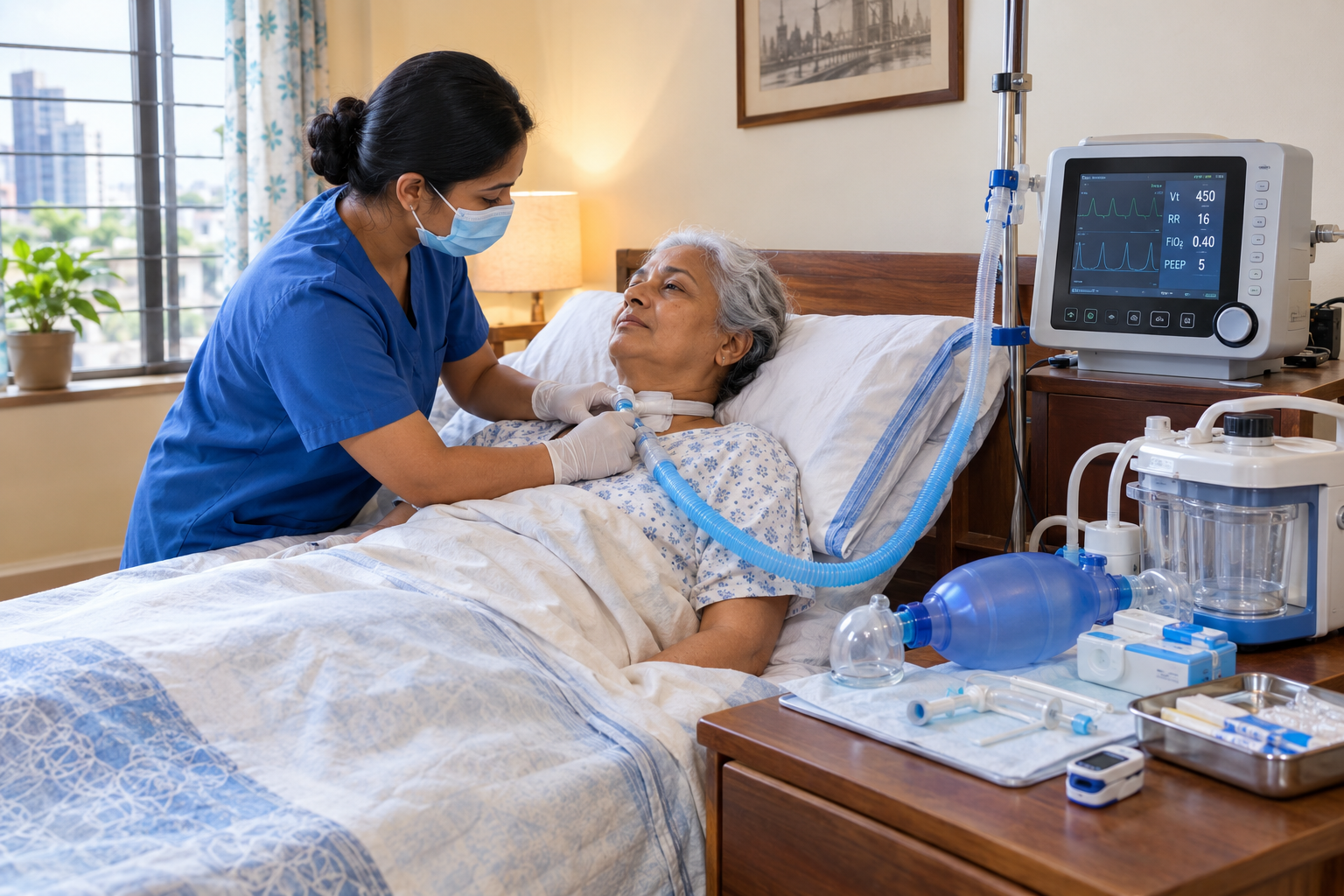
The doctor says your mother can go home next week. Then comes the second sentence: she’ll be going home on a ventilator. Most families we meet in Kolkata go quiet at that point. The good news is that care of patient on ventilator at home is very doable when the setup, the training and the backup plans are ready before the ambulance pulls up outside your building.
This guide covers what home ventilator support looks like day to day, what to keep at the bedside, which alarms matter, and how to write a care plan for ventilator patient needs that still works at 2 a.m. during a power cut.
What Home Ventilator Support Involves
A ventilator moves air into the lungs when a person can’t breathe well enough on their own. Doctors call this mechanical ventilation, and at home it usually takes one of two forms.
- Non-invasive ventilation, typically a BiPAP machine with a face or nasal mask. Common for COPD and some neuromuscular conditions.
- Invasive ventilation through a tracheostomy tube in the neck, for patients who need ventilator support for most of the day or round the clock.
The second type needs far more hands-on work, mainly suctioning and stoma care. Ask the pulmonologist which one your family member will use and for how many hours, because the whole care of patient on ventilator routine is built around that answer.
Get These Sorted Before Discharge
Equipment at the Bedside
Safe care of patient on ventilator starts with what’s within arm’s reach of the bed.
- The ventilator, with a charged internal battery and ideally a spare external one
- An Ambu bag (manual resuscitator) that every caregiver has practised with
- Suction machine, sterile catheters and saline
- A pulse oximeter for oxygen readings
- Spare tracheostomy tube in the same size, plus one size smaller for emergencies
- HME filters or a heated humidifier, because machine air dries the airway fast
The Room
Pick a room close to the main door if you can. Plenty of older homes in north Kolkata and Behala have steep, narrow staircases, and you don’t want to find out during an emergency that a stretcher won’t turn on the landing. Plug the ventilator straight into a wall socket rather than an extension board, and leave space on both sides of the bed so two people can turn the patient.
Power Backup
This is the one Kolkata families underestimate. Kalbaishakhi storms in April and May, and heavy monsoon rain later, both bring outages that can last hours. No amount of ventilator care training helps if the machine dies. Get an inverter or online UPS sized for the ventilator plus any oxygen concentrator, ask the supplier how long the internal battery lasts on your settings, and write that number on the machine.
Building a Daily Care Plan for Ventilator Patient at Home
Every patient is different, so treat this as a framework to adapt with your doctor.
Morning
Check that the ventilator settings match the discharge sheet. Families are rarely told this, but settings occasionally get bumped during cleaning. Note SpO2, pulse and temperature in a notebook. Then do tracheostomy care: clean around the stoma, change the dressing and check the ties allow one finger underneath.
Through the Day
- Turn the patient every two hours to prevent pressure ulcers
- Keep the head end raised 30 to 45 degrees, which lowers the risk of ventilator-associated pneumonia
- Suction only when you hear gurgling, see secretions or notice oxygen dropping, and keep each pass under 10 to 15 seconds
- Drain water in the tubing away from the patient, never back toward the airway
- Mouth care twice a day, minimum
- Tube feeds with the patient sitting up, as the dietitian advised
Ten minutes of chest physiotherapy and passive limb movement twice a day makes a visible difference to secretions and stiffness.
Night
Most problems in care of patient on ventilator at home show up at night. Someone trained has to stay awake. Not dozing on a chair with the TV on. Awake, and close enough to hear an alarm over a ceiling fan.
Ventilator Care Alarms and What They Usually Mean
Good ventilator care is mostly about reacting calmly to alarms.
- High pressure usually means secretions, coughing or a kinked tube. Suction or straighten the circuit.
- Low pressure or disconnect: something has come loose. Check every connection from machine to patient.
- Low battery means mains power has gone. Switch to backup now.
- An apnoea alarm means the patient isn’t triggering breaths. Check the person first, the machine second.
If you can’t fix the cause within seconds and the patient looks distressed, disconnect, breathe for them with the Ambu bag and call for help.
When to Call the Doctor the Same Day
- Fever above 100°F
- Secretions turning thick, green, foul-smelling or bloody
- Oxygen staying below the target your doctor set
- New confusion or unusual drowsiness
- The trach tube slipping out (replace it if trained, then call)
Who Handles the Care of Patient on Ventilator? Family, Nurse or Both
Our honest view: family alone can’t manage this for long. Ventilator care runs 24 hours, and exhaustion leads to missed alarms. The mistake we see most often is hiring a general attendant with no ICU background because it’s cheaper. For invasive ventilator support, you want an ICU-trained nurse for at least the first few weeks, while two family members learn suctioning and bagging alongside them.
Many of these patients are also bedridden, so the routines in our guide on nursing care of bedridden patient at home overlap closely. For older parents on long-term ventilation, our Senior Citizen Care Services Kolkata team covers daily nursing. Where the illness is progressive, such as ALS or end-stage COPD, our Palliative Care Services in Kolkata focus on comfort and help families manage end-of-life symptoms at home.
For NRI families, a daily photo of the readings notebook and a weekly video call with the nurse settles a lot of worry from abroad.
Your Next Step
If discharge is a week away, start today: book a ventilator demo with the vendor, confirm your backup run time and arrange a trained nurse for the first night home. Kurves Kare India can assess your home anywhere in Kolkata and put together the care plan for ventilator patient routines, staff and equipment list before your family member leaves the hospital.
Frequently Asked Questions
Can a patient on a ventilator be cared for at home in Kolkata?
Yes. With a stable condition, doctor’s approval, trained nursing staff and reliable power backup, care of patient on ventilator at home is common in Kolkata today, including for long-term tracheostomy patients.
How much does home ventilator care cost in Kolkata?
It depends on whether you rent or buy the machine, the type of ventilation and the hours of nursing. Ask for an itemised quote that separates machine rental, consumables and nurse shifts so you can compare properly.
Does a ventilator patient at home need a nurse 24 hours a day?
For invasive ventilation, usually yes, at least until family members are trained. Patients on night-only BiPAP ventilator support often manage with a few nursing hours plus family help.
How often should a tracheostomy be suctioned?
Only when needed, not on a fixed clock. Gurgling, visible secretions, coughing or a fall in SpO2 are the usual signs.
What happens to a home ventilator during a power cut?
Most switch to the internal battery automatically. Check the remaining time on screen, move to your inverter or UPS, and keep the Ambu bag close in case both fail.